
Now Reading: The Dorky Review Show Praises JQX’s Creative Formula: “He Don’t Come to Play”
-
01
The Dorky Review Show Praises JQX’s Creative Formula: “He Don’t Come to Play”
Advertisement



Advertisement
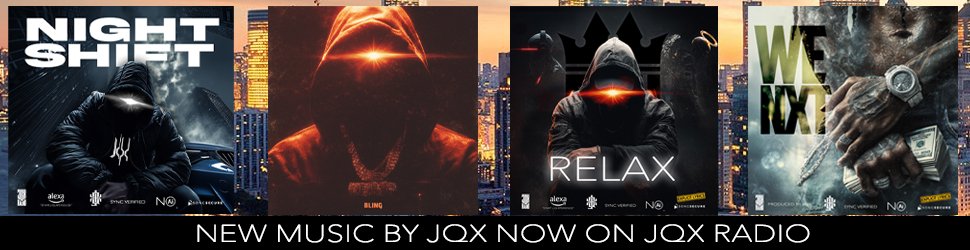
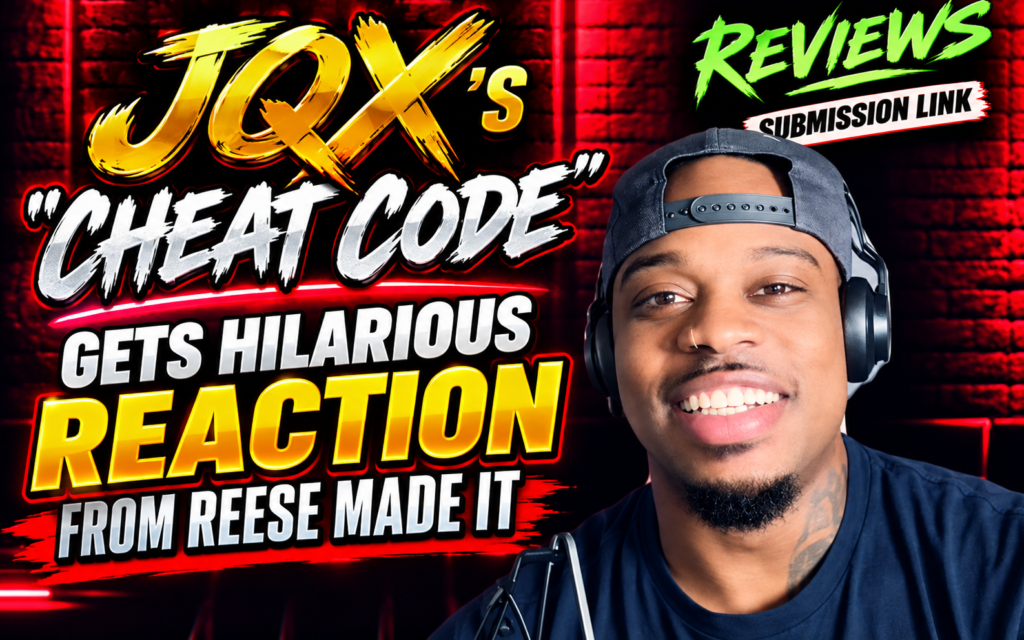
JQX continues to make an impression on independent music reviewers, and during a recent episode of The Dorky Review Show, the conversation surrounding his track “Rumors” quickly became about something much bigger than one song.
Before even getting deep into the record, the host made it clear that a certain level of expectation now comes whenever the JQX name appears.
“JQX… excited to see what we have today. He don’t come to play, man. He do not come to play.”
That anticipation appears to have been earned over multiple submissions. The reviewer went on to question whether the show had even heard a bad JQX record yet, while describing each new submission as another part of what has become the larger “JQX experience.”
More Than an Artist
One of the biggest compliments from the review centered on JQX’s versatility.
Rather than viewing him simply as an artist performing over production created by someone else, The Dorky Review Show highlighted his ability to operate as both an artist and producer, giving him the freedom to build records from multiple creative angles.
“You are an artist slash producer,” the host said, pointing out that JQX can get behind the scenes and “pretty much do a lot of things.”
That distinction has become increasingly important to the JQX catalog.
The music may carry the energy of records designed for clubs, parties and high-energy environments, but according to the reviewer, there is usually another layer underneath the production.
That is precisely what separates JQX from the type of club music the host normally avoids.
“I don’t normally like club records,” the reviewer admitted before explaining that JQX feels different.
“There’s something that you do where I don’t feel like you’re dumbing yourself down.”
It’s a powerful observation because it identifies one of the central characteristics behind the growing JQX catalog: high energy doesn’t have to mean low creativity.
Turning Music Reviews Into Music
The show also singled out one of JQX’s more unconventional creative strategies — taking reactions from music reviewers and transforming those reactions into entirely new productions.
Instead of allowing a review to exist as a single moment, JQX has repeatedly found ways to sample, reinterpret and incorporate reactions into another beat or record.
The Dorky Review Show described the strategy as almost “meta” in the way it continues building upon itself.
According to the host, hearing yourself unexpectedly become part of a record creates an experience that almost anyone would find exciting.
It transforms the traditional relationship between artist and reviewer.
The review isn’t necessarily the end of the conversation.
Sometimes, the review becomes part of the next record.
“I Quit” Is Still Making an Impact
While the latest submission was “Rumors,” another JQX record clearly remains on the host’s mind: “I Quit.”
The reviewer revealed that he continues playing the song for other people even when JQX isn’t part of the conversation.
“I gotta know how many times I play that for people when you’re not in the building,” he said.
More importantly, he uses “I Quit” as an example when discussing artists who believe they have to sacrifice ideas or substance to make music capable of working in a club.
For The Dorky Review Show, “I Quit” proves otherwise.
The production can still make people dance, but the concept gives the song an identity beyond the beat.
The reviewer even imagined the song becoming the soundtrack for people dramatically quitting their jobs — including employees forming a conga line on the way out of the building.
It’s funny, but it also demonstrates why the concept stuck with him.
With the right visuals and social-media moment, he believes the idea has genuine viral potential.
“If you think you about to quit your job… you do a conga line out the door playing the song and watch what happens.”
The fact that a previous submission continues to generate ideas long after its original review may be one of the biggest compliments an artist can receive.
“Rumors” Arrives With Expectations
That history is now creating something valuable for JQX: expectation.
When “Rumors” appeared on The Dorky Review Show, the host wasn’t approaching the name as an unknown submission buried inside a playlist.
There was already anticipation.
There was already familiarity.
And there was already a track record.
“Every record that you’ve made and put out has a certain level of energy,” the reviewer said.
That consistency appears to be becoming part of the JQX identity.
The records may change themes, concepts and production approaches, but listeners familiar with the catalog are beginning to expect something distinctive whenever the name appears.
The JQX Experience Keeps Growing
Perhaps the most interesting part of The Dorky Review Show’s reaction is that the discussion moved beyond whether “Rumors” was simply good or bad.
The conversation became about how JQX creates.
It became about the production.
The concepts.
The marketing possibilities.
The interaction with reviewers.
The ability to create danceable music without abandoning ideas.
And the growing expectation attached to every new submission.
That may ultimately be more valuable than receiving a positive score on a single record.
JQX isn’t only introducing reviewers to individual songs anymore.
He is introducing them to a creative world where one record can lead to a review, the review can inspire another production, and that production can become another chapter in an expanding catalog.
As The Dorky Review Show put it:
“You continue to make dope records over time.”
And with “Rumors” adding another chapter to that run, the JQX experience continues to build.
Related Posts

Stay Informed With the Latest & Most Important News
Previous Post
Next Post

Advertisement